Classical Islamic Scholar's Forgotten Method Reveals How Muslim Parents Can Raise Obedient, God-Fearing Children Without Shouting, Punishment, or Destroying the Parent-Child Bond Forever | Muslim Parenting Matters Kenya
Muslim Parenting Matters
No. 1 Islamic Parenting Resource for East African Muslim Homes
⏳ This Launch Price Closes In:
--
Hours
:
--
Mins
:
--
Secs

Classical Islamic Scholar's Forgotten Method Reveals How Muslim Parents Can Raise Obedient, God-Fearing Children Without Shouting, Punishment, or Destroying the Parent-Child Bond Forever

Fatimah — Nigerian Muslim Mother

You know that feeling when you've said the same thing to your child five times... and they still haven't moved?

You're standing there. Voice raised. Heart racing. And they're just... looking at you. Or worse, looking at their phone.

Why won't they just listen to me?

You punish them. You take away the phone. You send them to their room. And for a few days, things are quiet. But then everything goes back to exactly the way it was. Or worse.

They become colder. More distant. They answer your questions in one word. They stop telling you things. And somewhere in the back of your mind, a fear starts to grow...

Am I losing my child?

You look at other Muslim families and their children seem respectful, obedient — they greet elders without being told, they sit properly in the mosque. And you wonder: what are they doing that I'm not doing?

You shout. They shut down. You lecture them about akhirah. Their eyes glaze over before you finish the first sentence. You try the cane. They become secretive. They stop bringing their problems to you. They find other people to talk to.

Where did I go wrong?

The house feels tense. Your husband notices. "What's wrong with this child?" As if you don't already carry that question everywhere — in the car, in the kitchen, in the middle of the night when you can't sleep.

You go online. You find parenting videos from Muslim influencers. They talk about "gentle parenting" and "emotional regulation." It all sounds beautiful. But when you try it in your actual Nigerian home, with your actual Nigerian child, it falls flat completely.

Is this just who my child is? Have I already damaged them? Is it too late?

You carry all of this alone. Because Nigerian Muslim mothers don't talk about these things openly. You smile at the masjid. You say "Alhamdulillah, they're fine." But inside, you are scared.

I know exactly how that feels. Because I lived it.

Drop everything you are doing now and listen to every word I'm about to say.

Because I'm about to share with you a simple classical Islamic method that changed everything — and it came from a place I never expected.

Our grandmothers knew something we have forgotten.

Before hospitals. Before parenting books. Before YouTube. The Muslim women who raised the scholars, the hafiz, the righteous men and women of our ummah — they had a method. Passed down quietly, from mother to daughter, from scholar to student, from elder to young parent.

But somewhere between their generation and ours, that knowledge got lost. We replaced it with Western parenting advice that was never designed for Muslim homes. And we have been struggling ever since.

The method I'm about to share is not new. It is over a thousand years old. It comes from the books of Imam Al-Ghazali and Ibn al-Qayyim — men who wrote about the architecture of the child's soul with a precision that still leaves modern psychologists in shock.

Hi, my name is Fatimah.

First thing you should know about me: I am not a psychologist. I am not an Islamic scholar. I am not a parenting coach with a certificate on the wall.

I am just a regular Nigerian Muslim mother from Lagos who saw hell for a long time — until the day I sat in a small room in Ibadan and an old man changed everything I thought I knew.

Fatimah reading the Quran with her children

My Story: How I Almost Lost My Son Before I Found the Answer

I was raised in a strict Muslim home in Ibadan.

My father was a quiet man, but when he spoke, everyone listened. My mother ran the house with an iron hand wrapped in a warm smile. Discipline meant the cane, silence, and no second chances. We turned out fine — or so I thought. So when I became a mother, I did exactly what they did.

I had three children. Abdurrahman was my firstborn — a brilliant, curious boy who used to follow me everywhere when he was small, asking questions about everything, holding my hand whenever we walked.

For years I told myself my parenting was working. The children were respectful in front of guests. They prayed when reminded. They greeted elders when told. On the surface, everything looked fine.

Then Abdurrahman turned twelve.

And something changed.

It started small. He stopped looking me in the eye when I spoke. His answers became one word. "Yes." "Fine." "Okay." He started spending every evening in his room with his headphones on, door closed. He prayed only when threatened with consequences.

I told myself it was teenage behaviour. I told myself it would pass.

It didn't pass.

One afternoon during the Eid holiday, I walked past his room and heard his voice through the door. He was on the phone with a friend. I stopped. I wasn't trying to eavesdrop. But what I heard froze me where I stood.

"My mum doesn't actually listen. She just shouts."

I stood in that hallway for a full minute. Then I walked quietly to my bedroom, closed the door, and sat on the edge of the bed.

I didn't move for a long time.

My husband Yusuf came home that evening and knew immediately something was wrong. "What happened?" I told him what I heard. He was quiet. Then he said, "Maybe he just needs more discipline." And I thought — that's exactly the problem. We've been using discipline as the answer for everything. And it's not working.

That was my breaking point.


I started looking for answers everywhere.

A family member suggested I send Abdurrahman to a stricter Islamic school. "The environment will straighten him out." I tried it. What happened instead was that he began associating Islam itself with pressure and punishment. He started resisting salah not because he didn't believe — but because everything connected to it felt like a threat.

I watched parenting videos from popular Muslim influencers. Beautiful women talking about "connection before correction" in their American accents from their tastefully decorated homes. I tried their suggestions. In my Lagos apartment, with my actual child, none of it landed.

I consulted older family members. "Just use the cane — that's how we were all raised and we turned out fine." We tried that too. Abdurrahman became colder. More secretive. The gap between us grew wider.

I increased the frequency of my corrections. Every mistake became a lecture. Every lecture became longer. Until I realised he had developed a complete hearing block — my voice had become background noise. He had learned to simply wait for me to finish.

I bought a parenting book from a Christian bookshop because nothing else was available — then felt guilty reading it and put it down after three chapters.

I even tried making more dua. Longer, more specific duas every fajr. I still believe in dua. But I also believe that Allah gives us knowledge for a reason — and I had not yet found the right knowledge.


It was my mother's elder sister — Aunty Risi — who changed the direction.

I was visiting Ibadan for the Sallah holidays, sitting in her parlour, and I finally told her the truth about what was happening. Something about Aunty Risi — she was 72, she had raised eight children and not one of them had gone astray — made me say everything out loud.

She listened without interrupting. Then she said: "Fatimah. There is an old man at the mosque here. Ustaz Ibrahim. He has been teaching Islamic studies for forty years. Three of his children are hafiz. His grandchildren are known throughout this town for their character. Go and talk to him."

I went the next Thursday evening, after Maghrib.


His room was small. Floor to ceiling, old Arabic books in worn leather covers. He was a small, gentle man — white beard, soft eyes — the kind of calm that makes you feel like everything is going to be okay the moment he speaks.

I told him about Abdurrahman. He listened for twenty minutes without a single interruption. Then he leaned forward and said:

"My daughter. The problem is not your son. The problem is that nobody ever taught you how the child's soul was designed by Allah."

He explained that Imam Al-Ghazali — over nine hundred years ago — wrote in detail about what he called the Veil of Shame. The natural internal moral compass every child is born with. He explained how most parents, without knowing it, destroy this veil slowly — one public correction at a time, one shout at a time — until the child no longer feels shame from the inside. They only respond to external pressure. And when the pressure isn't there... nothing.

He told me about the 7-7-7 Rule — a narration from Ali ibn Abi Talib describing the three distinct stages of a child's development and the completely different approach a parent must take at each stage. He asked me what stage Abdurrahman was in. I told him — twelve years old. He nodded. "You are treating him like he is still in stage one. But he entered stage two. And stage two requires something completely different from you."

He explained Taghaful — the Prophet's own method of strategic overlooking. He gave me specific tools. Practical things I could start doing that same night.

I was skeptical. It all sounded too simple. But I was out of options. So I went home and I started.


The first few days — nothing changed. Abdurrahman was still the same. Door closed. Headphones on. One-word answers.

I kept going.

By the end of the first week, I noticed something small. He stopped slamming his bedroom door when he went in.

By the end of the second week, he started coming downstairs without being called for dinner and sitting with the family.

End of week three — he prayed Maghrib beside me. Without a single reminder. For the first time in over a year.

Then came the moment I will never forget. A random Tuesday evening, nearly a month after I started. Abdurrahman knocked on my bedroom door, came in quietly, and sat on the edge of my bed. And started to talk. Really talk. For the first time since he was a small child.

Yusuf noticed before I told him anything. One evening after Isha he said quietly: "I don't know what you did but my son greeted me properly today when I came home. He even asked if I needed anything. What happened to him?"

I smiled. "Nothing happened to him. We just stopped working against the way Allah designed him."


After Yusuf noticed the change in Abdurrahman, I couldn't keep what I had learned to myself.

I started sharing it quietly. First with my sister-in-law Hajiya Ruqayyah, whose thirteen-year-old daughter had stopped wearing hijab at home and refused to discuss it. Then with Sister Khadijah from our mosque, whose ten-year-old son had started lying about everything — his homework, where he'd been, who he'd spoken to. Then with two other mothers from our neighbourhood who had been struggling in silence the way I had been struggling in silence.

I shared exactly what Ustaz Ibrahim had shared with me. The Veil of Shame. The 7-7-7 Rule. Taghaful. The Sacred Vault. I explained it the way he had explained it to me, as simply and as practically as I could.

Within weeks, all four of them came back to me with the same look in their eyes that I imagine I had the night Abdurrahman sat on the edge of my bed and started talking.

Sister Ruqayyah's daughter came to her one morning and asked her to help her find a nicer hijab style. Nobody had asked her to. Sister Khadijah's son stopped lying — not because he feared being caught, but because something had shifted inside him about who he wanted to be.

That was when the messages started coming in from people they had told.

After the fifth mother messaged me asking me to explain the method step by step, I realised I had to write everything down properly.

I couldn't take individual calls. I couldn't repeat the same explanation twenty times a week. And I didn't want this knowledge to stay inside a small WhatsApp group when there are Nigerian Muslim parents who need it right now.

Every single thing Ustaz Ibrahim taught me — and everything I learned from applying it for months — is now inside this guide.

Introducing...
The Complete Edition
Discipline Without Damage
The Classical Islamic Method for Raising Obedient, God-Fearing Children
Without Anger, Fear, or Regret
Discipline Without Damage — Complete Edition

📖 Inside the Main Guide, You'll Discover:

  • →
    The Veil of Shame — what it is, how most Nigerian Muslim parents unknowingly destroy it one correction at a time, and the exact steps to begin restoring it in your child starting tonight. — Pg. 4
  • →
    Taghaful: The Prophet's Method of Strategic Overlooking — when to use it, when not to, and why it produces deeper and more lasting obedience than any punishment ever could. — Pg. 5
  • →
    The 7-7-7 Rule from Ali ibn Abi Talib — the three developmental stages of every child's soul and exactly what your role must be at each one. Most parents are unknowingly applying the wrong approach at the wrong stage — and this is why nothing is working. — Pg. 7
  • →
    The Overhead Praise Technique — a surprisingly simple method for building your child's confidence and good character without them even realising you are doing it. — Pg. 8
  • →
    The 70/30 Rule for Discipline — how to save your parenting authority for the corrections that actually matter, and stop wasting it on the small things that have turned your voice into background noise. — Pg. 9
  • →
    Finding Your Child's Fath — the classical Islamic framework for identifying your child's God-given path and stopping the comparison virus that quietly destroys their motivation and self-worth. — Pg. 13
  • →
    The Sacred Vault — how to become the one person your child trusts completely with their worst moments, so they come to you instead of hiding from you — for the rest of their life. — Pg. 17
And the best part? You don't need to be a trained Islamic scholar, you don't need to completely change your parenting style overnight, and you don't need to spend anything extra. It's the same method that worked for me — and has now worked for over 280 Nigerian Muslim parents who have applied it.
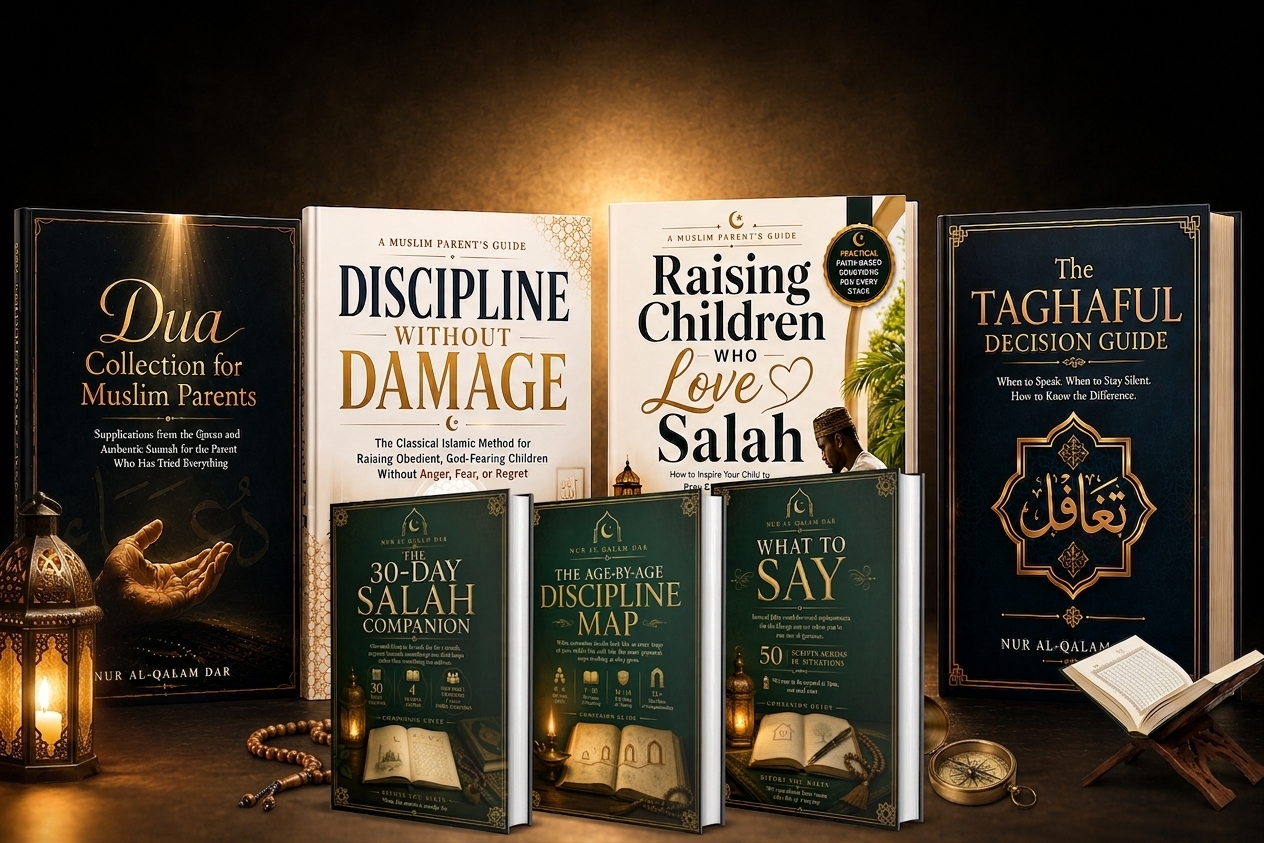
Companion Book — Included You also receive this full standalone guide alongside
Discipline Without Damage at no extra cost
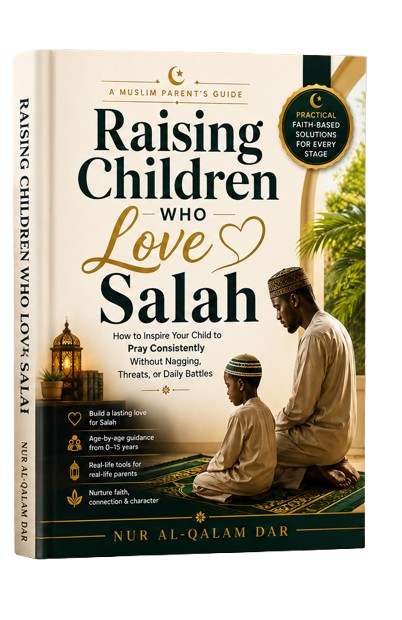
Raising Children Who Love Salah

Raising Children Who Love Salah

Sold separately at KSH 850

A complete standalone guide on building a genuine, lasting love of salah in your child — not compliance out of fear, but a relationship with salah that comes from the inside out. Covers the psychology of salah resistance, why lecturing and threatening backfires, and the classical Islamic methods for making salah the anchor of your child's day — from early childhood through the teenage years.

📚 This is a full standalone product. You're receiving it as a companion to Discipline Without Damage at no extra charge.

🎁 Plus 5 Free Bonuses — Included With Your Order

Order today and these five practical tools come with your complete package at no additional cost.
What to Say Instead — 50 Scripts

Bonus 1 — What to Say Instead

Value: KSH 600

50 word-for-word scripts replacing the phrases that shut children down — for real situations: defiance, lying, salah resistance, disrespect, sibling conflict. Open it. Use it tonight.

Age-by-Age Discipline Map

Bonus 2 — The Age-by-Age Discipline Map

Value: KSH 460

A clear visual guide showing exactly which discipline approaches work at which age — so you stop applying a seven-year-old's correction method to a fourteen-year-old and wondering why it fails.

30-Day Salah Companion

Bonus 3 — The 30-Day Salah Companion

Value: KSH 390

A day-by-day companion for the first 30 days of rebuilding your child's relationship with salah. Small, specific actions for each day — no overwhelm, no massive overhaul. Just one thing a day.

Taghaful Decision Guide

Bonus 4 — The Taghaful Decision Guide

Value: KSH 260

A one-page printable tool for deciding in real time whether to correct your child's mistake or apply strategic overlooking — so you never waste your parenting authority on the wrong battle at the wrong moment.

Dua Collection for Muslim Parents

Bonus 5 — Dua Collection for Muslim Parents

Value: KSH 195

Duas from the Quran and authentic Sunnah for parents making dua for their children's guidance, obedience, and righteous character — with Arabic text, transliteration, and full meaning.

Everything included in the Discipline Without Damage Complete Edition

Everything you receive: Main Guide + Companion Book + 5 Bonuses

📦 Here's Everything You're Getting Today

📖 Discipline Without Damage (Main Guide) KSH 1,999
📚 Raising Children Who Love Salah (Companion Book) KSH 850
🎁 What to Say Instead — 50 Scripts KSH 600
🎁 Age-by-Age Discipline Map KSH 460
🎁 30-Day Salah Companion KSH 390
🎁 Taghaful Decision Guide KSH 260
🎁 Dua Collection for Muslim Parents KSH 195
Total Value KSH 4,500
You pay today — during this launch window only:
KSH 999.99
One-time payment · Instant digital delivery · No subscriptions

Real Parents. Real Testimonials.

Over 280 Nigerian Muslim parents have applied this method in their homes.
ZA
Maryam Abdalla
🇰🇪 Mombasa, Kenya
3 days ago
★★★★★
Wallahi, this guide is not like anything I have read. My daughter was 13 — rude, always arguing, refusing to pray unless I stood over her. I read it in one night. The Veil of Shame chapter — I cried because I finally understood what I had been doing wrong. After three weeks, my daughter came and asked me on her own to help her memorise a surah. Nobody asked her. May Allah reward the author. Ameen.
HM
Rahma Kamau
🇰🇪 Nairobi, Kenya
1 week ago
★★★★★
I bought this for my husband to read because he was the one with the heavy hand in our home. By the second chapter he came out of the room and said "I think I have been doing this all wrong." We read it together. The 7-7-7 Rule changed how we think about our children completely. Our son is 10, our daughter is 15 — and we finally understood why the same approach cannot work for both of them. Alhamdulillah. This is worth ten times what they charged.
FK
Amina Hassan
🇰🇪 Kisumu, Kenya
1 week ago
★★★★★
I don't usually write reviews but I have to do this one. My son had stopped greeting his father when he came home. For months. My husband was very hurt but didn't know how to reach him. We applied the Taghaful method for two weeks. One evening my son came downstairs and said "Baba, how was your day?" My husband called me immediately after. This thing works. It actually works. Buy it. Don't wait.
UI
Umm Yusuf Al-Ansari
🇰🇪 Nakuru, Kenya
2 weeks ago
★★★★★
As someone who studied a bit of Islamic studies myself, I was skeptical. I thought I already knew the classical references. But the way this guide explains the Veil of Shame and how it gets destroyed — I had never seen it explained in that practical, actionable way before. The scholarship is solid. The application steps are clear enough that even a busy working mother can follow them. Highly recommended for any Muslim parent.
MY
Zainab Omar
🇰🇪 Eldoret, Kenya
2 weeks ago
★★★★★
I had tried everything for my 11 year old. The cane, the threats, the long lectures about hellfire — nothing. After reading this guide and applying the Sacred Vault method especially — this child opened up to me within one month in a way he never had in his entire life. He told me about a problem he had been hiding for six months. I wept. This is not just a parenting guide. It is a repair manual for broken bonds.

📝 Share Your Experience


Just So You Know... Putting This Complete Edition Together Took Over 12 Months and Significant Investment.

  • ✓ 12+ months of deep research into classical Islamic scholarship — Al-Ghazali's Ihya, Ibn al-Qayyim's Tuhfat al-Mawdud, and the authenticated Prophetic traditions on child development
  • ✓ Professional writing, editing, and scholarly review across the main guide, companion book, and all five bonus materials
  • ✓ Extensive testing with real Nigerian Muslim families before anything was finalised
  • ✓ Professional design and formatting across seven separate pieces of content
  • ✓ Secure delivery infrastructure so everything reaches you within seconds of payment

A proper Islamic parenting course from a qualified scholar costs KSH 6,500 or more.

A family counselling session costs KSH 3,000 — per session, and you'd need several.

I'm not going to charge you anywhere near that.

I won't even charge you KSH 3,200...

Not even KSH 1,950...

In fact you won't even pay the full combined value of KSH 4,500.

Because right now — for the next 72 hours only — you can get the complete edition at a launch price that makes it impossible for any serious Muslim parent to say no.

⏳ Launch Price Closes In:
--
Hours
:
--
Mins
:
--
Secs

📦 Everything You Get Today

📖 Discipline Without DamageKSH 1,999
📚 Raising Children Who Love SalahKSH 850
🎁 What to Say InsteadKSH 600
🎁 Age-by-Age Discipline MapKSH 460
🎁 30-Day Salah CompanionKSH 390
🎁 Taghaful Decision GuideKSH 260
🎁 Dua CollectionKSH 195
Total ValueKSH 4,500
Your price today — 72-hour launch window only:
KSH 999.99
One-time · Instant delivery · 30-day money-back guarantee
⚠️ This Launch Price Is ONLY Available For The Next 72 Hours. After That, The Price Returns to KSH 1,999.
👉 Get The Complete Edition — KSH 999.99 Only
Secure checkout · Pay by card, M-Pesa, or bank transfer · Instant delivery


🛡️

Still Feeling Unsure? Here Is My Promise.

Read the complete guide. Apply the methods with your child consistently. Give it 30 days.

If you see absolutely no change in your child's behaviour or in your relationship with them — send me a single message and every shilling you paid will be refunded immediately. No questions asked. No forms to fill. No arguments. No delays.

You have nothing to lose. Your child's relationship with you is worth far more than KSH 999.99. And I am confident enough in this method to stake my reputation on it.


More Parents. More Results.

What happened after they applied the method in their homes.
SR
Safiya Rashid
🇰🇪 Mombasa, Coast
5 days ago
★★★★★
Honestly I was about to give up on my 14 year old son completely. He had become like a stranger in the house — cold, disrespectful, rolling his eyes whenever I talked. We read this guide together and the thing that changed us most was the 70/30 rule. We realised we had been correcting everything and he had just stopped listening to any of it. Three weeks later he voluntarily told his father about a problem he had at school. In our house, that was a miracle.
RA
Rahma Odhiambo
🇰🇪 Kisumu, Nyanza
1 week ago
★★★★★
The companion book on salah was something I didn't know I needed until I read it. My son had always prayed under pressure — but after applying the methods in the salah companion, I watched him begin to pray on his own. Not every time. But it started. The section on Finding Your Child's Fath in the main guide also made me cry — I realised I had been comparing my quiet, artistic daughter to her outgoing brother for years. I stopped. I changed. She has blossomed. Buy this whole package. Read it twice.
AI
Amina Wanjiru
🇰🇪 Nairobi, Nairobi
10 days ago
★★★★★
My son age 10 had started lying about everything. The guide's explanation of why children lie when the Veil of Shame has been damaged — I had never heard this before. It reframed everything. After applying what the guide taught, the lying stopped within three weeks. Not because he feared punishment. Because something changed inside him. The What to Say Instead bonus is also something I use every single day now. If you have a child who lies, buy this immediately.
NU
Nusaybah Said
🇰🇪 Malindi, Kilifi
2 weeks ago
★★★★★
I shared this complete package with four other mothers in my neighbourhood and all four of them saw results. One had a teenage daughter who had completely refused to wear hijab at home — within five weeks the daughter came to her mother and asked for help finding a better hijab style. Another had a son who had not spoken a full sentence to his father in eight months. Now they sit and talk after Isha. The method works.
KO
Khadija Mutua
🇰🇪 Nakuru, Rift Valley
3 weeks ago
★★★★★
I'm getting married soon and don't have children yet — but I bought this entire package because I want to be prepared before I need it. Prevention is better than repair. The scholarship in this guide is serious — it is not opinion. It is grounded in our tradition. The Age-by-Age Discipline Map alone taught me things about child development I wish every Nigerian Muslim parent knew from day one. I am telling everyone I know.

You Now Have Two Choices.

✅ Option 1 — Take Action

Get the Complete Edition today. Apply the classical Islamic method in your home. Watch your child begin to open up, obey from the inside, and love their deen — not out of fear, but out of a bond you rebuilt together. Seven tools. One price. Thirty days to see the difference.

❌ Option 2 — Close This Page

Close this page and keep doing what hasn't been working. Keep shouting into the silence. Keep watching the distance grow. Keep trying solutions that were not designed for your child, your home, or your faith. Maybe next year something will change on its own. Only you know how much more time you're willing to lose.

Maybe Allah put this page in front of you today for a reason. The method exists. It works. 94 Kenyan Muslim parents are using it right now. The only question is whether you will be one of them.

⏰ The clock is ticking. The launch price closes soon.
⏳ Launch Price Closes In:
--
Hours
:
--
Mins
:
--
Secs
👉 YES! Get The Complete Edition + Everything — KSH 999.99 Only
30-day money-back guarantee · Instant delivery · One-time payment

© 2025 Muslim Parenting Matters Kenya  ·  Privacy Policy  ·  Contact

This is an Islamic parenting educational resource. Individual results may vary based on consistency of application.

Scroll to Top